"Quiet Life" / Ray Davies
I'm shocked to realize that I left one essential film out of our recent discussion of movie soundtracks: the Julian Temple film Absolute Beginners, a musical adaptation of Colin McInnes' novel (itself well worth reading) about 1950s London and the birth of British rock 'n' roll. If you haven't seen it, check it out -- it's one of my special little guilty pleasures. The story rambles more than a bit, but it's visually stunning, and it's appropriately packed with musical guest stars: David Bowie, Sade, Sandie Shaw, Zoot Money, Tenpole Tudor, and -- my primary reason for seeing the film in the first place -- the ever delicious Mr. Ray Davies.
I was reminded of this because, in my role as house historian for the Kinks Fan Club forum, I just posted that the Absolute Beginners soundtrack album was released 24 years ago today. Here's a clip of Ray's scene in the movie (hang in there, there's a minute or so of dialog before you get to the song itself).
Unfortunately this is only part of the movie in which Ray appears, but it's beyond wonderful. Playing the much-put-upon father of the main character, young photographer Colin, Ray doesn't exactly look glamorous in his undershirt and braces, his hair slicked back and grayed at the temples. (In contrast, Bowie is glam-tastic in his big scene). But Ray's bit is much more entertaining, and his dancing is simply to die for.
Anybody who was ever in doubt about Ray Davies' fondness for English music hall tunes only has to listen to "Quiet Life." Underlaid with Dixieland horns and jazzy percussion, it's a classic softshoe, tripping lightly along. Yet while the sound of the song is like Noel Coward champagne, the storyline is more Ealing comedy slapstick, with a Monty Python nudge-nudge wink-wink thrown in for good measure.
"Something's happening, but I'm just gonna turn a blind eye," Ray begins the patter, in his breathy, earnest innocent-bystander voice. "If I see no evil, I ask no questions and I hear no lies" -- his whole existence is a masterwork of self-protective denial. In low, confiding tones, Ray keeps suavely declaring that he's not such a fool as everyone thinks -- "Confidentially between these walls / I'm on top of it all." And indeed, he does see all the salacious shenanigans in his household -- it's like a saucy seaside postcard come to life. But he shows no intention of doing a bloody thing about it, so what's the point of knowing?
Listen to how Ray's voice trembles and squawks on the high-pitched refrain -- "All I need is a QUIET life!", like a blowsy trombone wail. Keeping his head in the sand takes every ounce of energy this hapless bloke has. It's a lovely little comic portrait, and Ray hits every mark. Oh, the rest of the soundtrack has some other gems -- I particularly love Bowie's rendition of the theme song, Style Council's "Have You Ever Had It Blue?", and Sade's "Killer Blow." But in the end, there's one reason I go back to this film again and again. Ray.
Showing posts with label movie music. Show all posts
Showing posts with label movie music. Show all posts
Saturday, March 20, 2010

Monday, March 08, 2010
Music for Movies
Still recovering from my 100 Singles project -- but while I take a breather, a few thoughts about the nature of music in films, inspired by Nat over at Another Aging Hipster. . . .
Watching the Academy Awards telecast last night -- the one annual ritual that I hold sacred, no matter how dimwitted and flatulent and ostentatious the whole exercise can be -- I was thrilled, of course, to see my old boyfriend Jeff Bridges win the best actor award (about time!), and to see T-Bone Burnett and Ryan Bingham pick up another statuette for the theme song to Crazy Heart. As the schlockfest lumbered on, between trips to the kitchen to refill my popcorn bowl, a thought occurred to me. Why don't they have a category for best compilation soundtrack? You know, as opposed to the best score category, which rewards only original composers, or the best song category, which is just for a single theme song. A great "various artists" soundtrack can totally sell a picture to me. In fact, I've often thought that that would be my dream job: To assemble songs for movie soundtracks. (Any studio honchos out there reading? You know how to reach me. )
As a music lover, I often pick my movies according to their music. Musical bio-pics are an easy sell for me, even for artists I didn't particularly like. (By the movie's end, inevitably I've become a fan.) We've had a string of good ones lately -- Cadillac Records, I Walk the Line, Ray -- but I'll go back farther. Val Kilmer as Jim Morrison in The Doors. That Jerry Lee Lewis thing with Dennis Quaid. The divine Jessica Lange as Patsy Cline (Sweet Dreams) and Sissy Spacek as Loretta Lynn in Coal Miner's Daughter. I even liked Lady Sings the Blues, and usually I can't stand Diana Ross. Done right, a good bio-pic is like a greatest hits album come to life, with really good liner notes.
Now, I would never buy the soundtrack CD for a movie like Star Wars or Lord of the Rings -- who buys those ponderous instrumental things? But I have been known to buy the soundtrack CD if the movie features a series of original songs, especially if they're performed in the movie, not just in the background. My favorite movie soundtrack of all time is Alan Price's 1973 songs for the Lindsay Anderson movie O Lucky Man!; that one's in a class by itself. But I really enjoyed Glen Hasard's soundtrack for Once -- I loved how the songs were worked into the story -- and thinking of Glen Hasard throws me back to another favorite soundtrack, for his first film The Commitments, an intriguing mix of scene-setting classic recordings and the actors performing other classic songs. If we're talking great original movie soundtracks -- again, songs, not just background score -- you have to mention the Bee Gees' triumph, Saturday Night Fever. I don't even like disco or the Bee Gees, and I get thrilled when the songs break out in that movie. How essential to The Graduate were those melancholy, satiric Simon & Garfunkel songs? And then of course there's one of the greatest rock soundtracks ever, A Hard Day's Night, which is so much better than all those other early 60s rock movies (ever see the Dave Clark Five's Having a Wild Weekend?), that it effectively killed the genre.
But I digress. As I work my way down my shelf of movie-related CDs, what I'm really thinking about today is those soundtracks that assemble already-existing songs slotted in to underlie the movie's story. Certain directors have a genius touch with this -- Oliver Stone, Wes Anderson, Martin Scorsese, and John Cusack come to mind (John Hughes could pull a few rabbits out of this hat too). All these guys are music lovers themselves, who bring that love to the films they direct. They know how a familiar song can establish the era, telegraph mood or character, and punctuate the story line. Back in the dinosaur days when they invented Oscar categories, popular music wasn't used in the same way, but pop culture has so come of age, that in the right hands music is as effective a tool as editing or visual effects for conveying a story. Using a song the audience already knows is more bang for your buck. Just think of how Scorsese used the songs in Mean Streets, for example -- the opening riffs of "Be My Baby" or "Jumping Jack Flash." You don't have to be a Kinks fan to love the use of "Nothin' in This World Can Stop Me Worryin' 'Bout that Girl" in Anderson's Rushmore, or "This Time Tomorrow" in The Darjeeling Limited.
In the right hands, music can define time with surgical precision. Think about the Coen Brothers' brilliant O Brother! Where Art Thou?, the soundtrack of which had my head ringing with Depression-era music for months. Half the reason Forrest Gump was so much fun was because its soundtrack swiftly pinpointed each year of Forrest's march through history. American Graffiti would have been nothing without its nonstop stream of vintage rock and roll hits. I didn't even see the movie Bobby, but I've got the soundtrack -- as an aural portrait of 1968 it can't be beat.
Even more so lately, it's become a reliable index to the hipster quotient of a film to have a witty soundtrack compiled of alternative tracks mixed with lesser-known album cuts from classic artists. The Zach Braff film Garden State had a brilliant soundtrack that introduced me to tons of cool indie bands. Go back a couple of years farther to Empire Records, which assembled a great bunch of songs for its story about a day in the life of an indie record shop. Even better is the soundtrack John Cusack put together for his record-store geeks in High Fidelity. (And even better than that was Cusack's soundtrack collection for Grosse Pointe Blank.)
Just in the past year, I loved the soundtracks for (500 Days of) Summer (cool use of the Smiths!) and the deeply evocative period piece Taking Woodstock. The charming little film Nick and Nora's Infinite Playlist was so totally about music, and what it means to certain kids, that it absolutely depended on having a killer soundtrack. Same with Pirate Radio -- you can't tell the story of the UK's 1960s offshore radio stations without a stream of the kind of music that those stations championed.
But it's late, and I'm sure I'm forgetting some. So tell me -- what are YOUR favorite music movies and movie soundtracks?
Thursday, December 10, 2009
"These Roads Don't Move" / Jay Farrar and Benjamin Gibbard
What's with all these "side projects"? Back in the day, you were either in a band or you weren't. Remember how Eric Clapton had to break up Cream before he could be in Blind Faith? But now you've got guys like Jack White, who can do White Stripes and the Raconteurs and who knows how many other bands all at the same time. Or those guys in Monsters of Folk, Conor Oberst and M. Ward and Jim James, all of whom belong elsewhere. Jeff Tweedy dances in and out of Wilco, Golden Smog, and Loose Fur, then records with Billy Bragg, the Minus 5, 7 Worlds Collide -- jeez, when the guy wakes up in the morning, does he even know who he's working with today?
So yeah, I was skeptical about this One Fast Move project. It began as the soundtrack for a documentary about Jack Kerouac's novel Big Sur, enlisting Jay Farrar -- the alt-country pioneer of Uncle Tupelo and then Son Volt -- and Benjamin Gibbard of the indie pop band Death Cab for Cutie (not to mention his side project Postal Service). The pairing is hardly obvious. Sure, they both exhibit a depressive streak, but with Gibbard, the depression comes out like your seventh-grade boyfriend's wistful poetry; Farrar's brand of melancholy is hard-bitten and adult, best suited to grubby barrooms and high-plains truck stops. Marry all this to lyrics taken straight from Kerouac's scouring prose -- well, watch out, sister.
But to my surprise, I loved this album. (Read here for my Blogcritics review.) Forget the film, forget even the book: This album is on my permanent playlist for its musical merits alone. Dark as some tracks may be, they're balanced by exhilarating songs like "These Roads Don't Move." Admittedly, I'm a sucker for traveling songs, especially when they're a metaphor for getting a fresh start. But I love the central image of this song -- "These roads don't move, you're the one who moves" -- an almost Zen-like koan about how travel offers a glimmering hope of change.
Throughout the album, I love how Farrar's flexible melodies accommodate the extra syllables of Kerouac's prose, imposed on bedrock rhythms that make up for the lack of rhyme scheme. Different melodies convey different moods, and Gibbard takes the lead vocal on the more tuneful, hopeful songs (which better suits his voice anyway). The passage Farrar chose for "These Roads Don't Move" is a rare island of optimism in the novel: "There is no need to say another word / It will be golden and eternal just like that / Something good will come of all things yet / Simple golden eternity blessing all." If there's irony there, it's dramatic irony; at this moment in the novel, Kerouac does believe in redemption and clean slates and all that sort of stuff. Notice how the melody soars upward at the end of lines, or nestles in a comforting little glissando phrase. And as the chorus repeats that "These roads don't move, you're the one who moves" mantra, it does so with a tuneful hook that swings you right down the road with it.
Verse two is more explicit about his journey: "Now get my ticket and say goodbye / And leave San Francisco behind / Go back home across Autumn America / And it'll all be like it was in the beginning." Verse three casts a shadow -- mentioning "dark torturous memories" and "irrational mortal loneliness" -- but by then we're just sailing along on that steady, wheeling beat, uptempo and bright. Yeah, there's the Western loneliness of a slide pedal steel guitar, but there are also shuffling drums (who knew Ben Gibbard was also a drummer?) and a brisk guitar strum to keep our narrator skipping right along.
I'm guessing this side project will be a one-time deal; Farrar and Gibbard are both too much in demand. If Kerouac hadn't brought them together, who would have imagined this? Yet Gibbard's honey and Farrar's grit add up to a beautiful and haunting album. I highly recommend.
Tuesday, November 10, 2009
"The Way Love Used To Be" / The Kinks
Well, I had to buy Percy to be a Kinks kompletist -- but I can't say I listen to it much. As a film soundtrack (and by all accounts the film is truly dreadful), it caters to the story rather than telling its own tale. All the Kinks play on it, but it doesn't much sound like a Kinks album.
NEVERTHELESS!
"The Way Love Used to Be" may not sound like a Kinks song, but it's still simply gorgeous. It isn't just the orchestral arrangement that's unusual (the Kinks never got hooked on string quartets like some bands did); its tender quality is something Ray Davies rarely employed on Kinks records. It's the sort of stuff he could handily turn out for TV themes, however, as he did for several BBC productions, like "Until Death Us Do Part" (the British series that America's All In the Family was copied from). A handful of these and other stray tracks are cobbled together on the rogue album The Great Lost Kinks Album, issued in the US by Reprise Records after the Kinks had moved to RCA. (Every time the Kinks changed labels, the old label would crank out a couple of tacky compilations to recoup their lost investment.) And what do you know, "The Way Love Used to Be" also appears on TGLKA, where it fits in just fine.
Listen carefully and you'll discover that "The Way Love Used To Be" has all the hallmarks of a Ray Davies song -- the secret handshake, if you will. There's the yearning to escape ("I know a place not far from here / It's not far away, love, but if you come / I know a place where we'll be alone"), the nostalgia for times past ("And we'll talk of life, the way love used to be"), the horror of modern civilization ("And we'll find a way through the city streets / We'll find a way through the mad rushing crowd"). Although Ray sings it with a tremulous flutter, for once it doesn't sound campy to me -- no, it's wistful and yearning, not hiding behind a scrim of irony.
Yes, the arrangement is old-fashioned, like something from the 1940s or early 1950s, with a pillow of strings and delicate classical accents. It's movie music, pure and simple -- something that wouldn't be out of place in a film like Brief Encounter or Mrs. Miniver. But I get the idea that Ray loves old movies, that he's totally into recreating this romantic, gently melancholy sound.
So what was a song like this doing in a movie about the comic adventures of a man with a penis transplant? I swear, it would almost be worth watching Percy to find out.
Almost.
UP NEXT: Muswell Hillbillies and "Have a Cuppa Tea"
Saturday, August 29, 2009
"Can't Find My Way Home" / Blind Faith
I've tried to resist all this Woodstock anniversary nostalgia -- no point in feeling fake nostalgia for a festival I never attended. But I broke down the other morning and snuck off to see Taking Woodstock, the new Ang Lee film. And really, I was more thinking of it as a Demetri Martin film; he's a stand-up comedy god in my household.
Demetri's character, Elliott, was the guy who hooked up the festival's producers with Max Yasgur's farm, which is about all the plot line you need. He doesn't spend much time at the festival itself, and never gets close enough to see the acts -- which saves us from the spectacle of watching, say, Mos Def impersonate Jimi Hendrix or Zooey Deschanel play Grace Slick. A fair amount of the famous music is played on the soundtrack, though, triggering all the Pavlovian responses. So what if, as we recently learned, some of the original Woodstock album was "sweetened" with better cuts of those same songs, culled from other concerts? The point is, you hear certain songs, you think "Woodstock." And then a beatific smile spreads over your face.
When this song came spooling through the movie, I thought, "Oh, yeah, another great Woodstock number." Trouble is, this song wasn't played at Woodstock. I guess it was thrown in because, in the movie, Elliott is slogging through the mud and the crowds, trying --get it? -- to find his way home. Engrossed in the movie, I didn't even register what song it was or who sang it; I just knew it sounded right.
Later on that day, I tried to track down that song, with its distinctive mad psychedelic swirl. "It's gotta be Traffic," I decided, "nobody sings that high and clear except Stevie Winwood." But a little research and I discovered that Traffic wasn't at the festival; Traffic didn't even exist in the summer of 1969. Dummy me, I hunted through all the other Woodstock bands before I realized I'd been right all along. It was Stevie Winwood, but with his next band, the "super-group" Blind Faith. And the song was from the summer of 1969, all right -- the only summer Blind Faith existed.
A lot of bands thought that a psychedelic song had to have imagistic lyrics -- gardens of Eden and cellophane flowers and white rabbits and all. Not Blind Faith. There are just two images in this song's lyrics -- the "throne" in the first line ("Come down off your throne and leave your body alone") and the "key" at the end of the verse ("You are the reason I've been waiting so long /Somebody holds the key"). But neither of these are arty images; they're things anybody would say in normal speech. And how about that last couplet: "But I'm near the end and I just aint got the time / And I'm wasted and I can't find my way home." Forget the coded drug messages everybody else was messing around with; this guy's telling you straight out what's up with him. He's high, okay?
As if anybody listening to this song could be in any doubt. The melody weaves around like a series of ocean waves, with a series of descending arcs -- cresting over the top, surging and receding, washing up on shore. There's only the one verse, anyway; after that it's just fragments of repeats, as if he's getting loster and loster. Then there's the undertow of nimble guitar picking that Eric Clapton lays down around those words -- more complication to get lost in. The samba-like rhythm pulses along, punctuated with an occasional shimmering cymbal bash from Ginger Baker, like the waves hissing onto the sand.
Despite the words, he isn't pleading; he just sounds bummed out and a little petulant. The woman he's trying to make love to is probably getting really pissed off by now, though I have to say, Winwood's boyish voice (winsome Winwood, I always call him) would be way too sweet for me to stay pissed off at him.
A gem of a song, an absolute gem. So what if it wasn't actually performed at Woodstock? Ang Lee wasn't about to get hung up on details like that. It's the sound of the summer of 1969, and a perfect evocation of the spirit of Woodstock. All this Woodstock nostalgia is fake anyway -- let's make it as hazy and groovy and far out as we can, okay?
Can't Find My Way Home sample
Thursday, August 27, 2009
"Be My Baby" / The Ronettes
In Memoriam: Songwriter Ellie Greenwich
There's a fantastic moment at the opening of Martin Scorsese's Mean Streets, one of my favorite movies of all time. Harvey Keitel sits up in bed with a jolt, waking up from some bad dream. He stumbles to the mirror, wipes the night sweats from his face, then sinks wearily back onto the bed. As his head falls back onto the pillow, we're assaulted by whomping drumbeats: Bomp buh-bomp, bump, bomp buh-bomp, bump. Then Ronnie Spector's shivery girlish voice swoops in: "The night we met I knew I / Needed you so / And if I had the chance I'd / Never let you go . . . ." Scorsese's soundtrack choices are never accidental; "Be My Baby" was throwing down a gauntlet for his hero. It spins us right into a world of single-minded passion, the sort of passion that Keitel's conflicted character, Charlie Boy, just can't summon up. There's the movie's conflict in a nutshell, laid right out in the opening sequence without a word of dialogue. You gotta know the songs, that's all.
I loved those 60s girl groups, and the Ronettes were at the top of the heap. I was still pretty young in their heyday, but those girl-group songs are an indelible part of my earliest music consciousness. I didn't yet have any "ideas" about music -- I just took it all in, with no prejudice about what I should be listening to. I wasn't even aware enough to know, a few years later, how many songs of the British Invasion groups were taken from the girl groups, with the genders switched -- Manfred Mann's "Doo Wah Diddy Diddy," Herman's Hermits' "I'm Into Something Good," and a host of album back tracks. I only knew that it had a beat and I could dance to it.
How many years of feminist education are undone as soon as a song like "And Then He Kissed Me" or "Leader of the Pack" comes on? I turn right back into an empty vessel waiting for a boy's love to complete me. Wrong, I know -- but I'd be lying if I didn't confess it was true. (As the Phil Spector murder trial showed us, that fantasy was dangerous even for the girl singers themselves. It took years for Ronnie Spector to come clean on how her Svengali, Phil Spector, abused her.)
And yet those song, those songs. The cool thing was that most of them were written by women -- or rather, by two husband-and-wife songwriting teams: Gerry Goffin and Carole King, and Jeff Barry and Ellie Greenwich. It just makes sense that female songwriters would "get" how a girl in love feels, even within the confines of mid-century pop traditions. It's even cooler that both those women songwriters went on to greater acclaim after they were divorced from their creative partners. When Carole King resurfaced as a singer-songwriter in the mid-1970s, she gave a second life to songs like "Will You Still Love Me Tomorrow?"; every girl in my freshman dorm owned her album Tapestry. Likewise, her counterpart Ellie Greenwich found a niche on Broadway, with the 1980s revue Leader of the Pack.
Ellie's classic "Leader of the Pack" was an amazing song in its own right, a mini-novel in song -- complete with sound effects! -- about a girl who loves a "bad boy" (haven't we all, ladies?) who dies in a motorcycle crash. But "Be My Baby" is the song that whooshed first into my head when I heard the news today of Ellie Greenwich's sad death, at only 68 years of age. Maybe it's that great whomping beat -- part cha-cha, part doo-wop -- loaded up with maracas and handclaps, with a schmear of schmaltzy strings in the bridge. "I'll make you happy, baby/ Just wait and see / For every kiss you give me / I'll give you three" -- it ain't profound, but the way Ronnie sings it, oh, is it heartfelt.
The chorus isn't quite call-and-response, but a clever hybrid -- call it repeat-and-embroider. "Be my, be my baby," the Ronnettes sing three times, while Ronnie adds, like the swirl of icing on the top, "Be my little baby," then "Say you'll be my darling," and "Be my baby now." Listen to how her voice slices right through Phil's wall of sound -- sassy, assured, knowing. This may not be feminism, but I'll lay my money on this chick getting whatever she wants.
"Da Doo Ron Ron," "Chapel of Love," "Hanky Panky," "I Can Hear Music" -- Ellie Greenwich cranked them out, song after song, in the great Brill Building tradition. They gave form to a generation of inchoate female yearnings, with their BFFs right there to add the back-up vocals. (Just listen to those girls confab in "Leader of the Pack": "'Get the picture?' / 'Yes, we see.'") And let's be honest: Ellie and Carole weren't that far off the mark. "Oh, since the day I saw you / I have been waiting for you / You know I will adore you / Till eternity" -- that's the gospel according to Ellie Greenwich.
Be My Baby sample
Tuesday, August 04, 2009
"Tuesday Afternoon" / The Moody Blues
I never gave the Moody Blues a chance, I'll admit it. When Days of Future Passed came out in 1967, my older brother and his friends couldn't stop talking about how it was the greatest album ever -- and I shut my mind tight like a steel trap. Maybe I was too young to get it (translation: too young to be taking the drugs you'd need), or maybe I was just unwilling to admit that my darling Beatles could be bypassed by more experimental bands. "Nights in White Satin" seemed humorless and pompous to me.
Of course, now when I hear "Nights in White Satin" and "Tuesday Afternoon," I'm totally manipulated by their rich swirl of sound -- it puts me straight back into the crazy soup of 1968. So when a friend gave me the soundtrack to the period film Bobby, this track wound up on my iPod. What's the harm in having a 1968 flashback every once in a while?
The trouble is . . . I don't think I ever listened properly to the lyrics. The other night I finally did -- and they are silly. Oh, not over-the-top silly, just wet-behind-the-ears silly. The setting is vaguely pastoral (emphasis on vague): "Tuesday afternoon," he begins -- that's specific, good so far. But then it gets lost: "I'm just beginning to see" (see what?) "Now I'm on my way" (way WHERE?) "It doesn't matter to me" (WHAT doesn't matter to you?) "Chasing the clouds away" (Who is chasing the clouds away -- and how?).
I know, I know, I'm being picky. These words should be listened to in the spirit intended, which is a questing heart on a journey of personal discovery. There should be a sense of mystery to it, a feeling of being on the verge of something momentous. "Something / Calls to me," he announces in verse two. "The trees are drawing me near" -- a visual image at last! But then Justin Hayward's vocal starts to go histrionic, with an urgent little slide: "Got to find out why / Those gentle voices I hear / Explain it all with a sigh." I suppose the gentle voices could be the wind, or some generalized murmur of nature, but I'm sorry, all I can imagine is overhearing a bunch of dippy hippies sitting in a grove mumbling about their mind-blowing philosophies.
Then the abrupt change of pace in the bridge perks me up for a moment; the song morphs suddenly into a jazzy shuffle, leaving behind the dreamy aural tapestry of the verse. Dare I hope for a thematic development? The singer for a moment seems to have a little more perspective: "I'm looking at myself, reflections of my mind / It's just the kind of day to leave myself behind." But despite the different tempo, there's no dramatic shift in the bridge, just more of the same hazy imagery: "So gently swaying through the fairyland of love, / If you'll just come with me and see the beauty of / Tuesday afternoon." And here comes the warbly synthesizers again -- watch out!
These lyrics aren't fatally bad, really. The Moody Blues could have gotten away with it if they'd done the song in a simple, folky style, like Donovan in his flower-child period, or even early Cat Stevens. But no, they had to layer on all those synthesizers and flutes and crashing cymbals etc. (That reedy waver in Hayward's voice doesn't help, either -- nowadays a producer would have done something to steady and fill out those vocals.) After all, that was their sound; lose that, and it wouldn't hardly be the Moody Blues. But the self-importance of that big dense sound promises so much more than the words deliver.
There are plenty of other reasons to dig this song. The Moody Blues pushed the frontiers of rock music, no question about it; the complex textures of this song, the instrumentation, the dense production, were all incredibly persuasive. I am, however, gratified to know that I never did believe in this band, not really. If I had, would I be able to pick this song apart like this?
Tuesday Afternoon sample
Saturday, April 18, 2009
"O Lucky Man!" / Alan Price
HAPPY BIRTHDAY ALAN PRICE!!
When I went to this movie's premiere run in the summer of 1973 in London -- the Leicester Square Cinema, I remember it well -- I was all hepped up about seeing Malcolm McDowell, who'd mesmerized me so in his previous film, A Clockwork Orange. But about four minutes into the film, Anderson cuts from a close-up of McDowell's face -- oh, those huge, sinister blue eyes -- to an image of hands crashing onto a electric piano keyboard. Commanding chords ring out, and the camera pans up to the finely-planed face of Alan Price, who begins to sing, in his smoky tenor voice, "If you have a friend / On whom you think you can rely / You are a lucky man." He rolls his eyes, grins, and goes on, "If you've found a reason /To live on and not to die / You are a lucky man."
Honestly, my heart leaped in my chest. It's one of the few moments in my life when I was aware of a life-changing event, of planets abruptly slewing around and re-aligning themselves. I walked out of that movie two-and-a-half hours later trembling, truly trembling. Yes, the story and the acting and the cinematography were fantastic -- I mean, it is Lindsay Anderson's masterpiece, a sweeping indictment of pre-Thatcherite England, and besides McDowell it stars brilliant actors like Helen Mirren and Ralph Richardson and Rachel Roberts. But to be honest, the only thing on my mind as I left the cinema was I must find out who this Alan Price is.
You think my current Nick Lowe obssesion consumes me? That's nothing compared to how I was obsessed by Alan Price throughout the late 1970s. And I still feel attached to him, like you might to your college boyfriend who never really dumped you, just eventually drifted out of your life. Even though he rarely records anymore, and hasn't toured the States in decades (I've only been able to see him live twice), Alan Price still is, and always will be, an immutable part of the soundtrack of my life.
The brilliant thing about the songs Alan Price wrote for this film (get this soundtrack album NOW) is how he marries jaunty pop music -- jazz, a samba, a cha-cha-cha, music-hall soft shoe, even a recycled hymn thrown in for good measure -- with bleak, disillusioned lyrics about the vanity of human endeavor. I'm talking lyrics like "Sell, sell, sell, sell everything you stand for" and "We all want justice but you've got to have the money to buy it" and
Hope springs eternal in a young man's breast
And he dreams of a better life ahead
Without that dream you are nothing, nothing, nothing You've got to find out for yourself that dream is dead.
I don't think of myself as a cynical person -- though, okay, my lifelong Kinks fanship suggests a certain jaundiced outlook -- but I sure bought into the deliciously dark world view of this movie. And this title track raises it to the level of an anthem, with unspooling arpeggios, spiraling melodic phrases, and mounting chord changes, as he declares the snarky truth: "Takers and fakers and talkers won't tell you / Teachers and preachers will just buy and sell you /When no one can tempt you with heaven or hell / You'll be a lucky man!"
Perhaps my favorite line in this whole song, the one that became my de facto motto, is "If knowledge hangs around your neck / Like pearls instead of chains / You are a lucky man." I wore a strand of fake pearls every day, my junior year of college -- fashionably pairing it with blue denim overalls -- as my trademark look, just because of this song. People who knew me in college still ask about the pearls.
I've seen O Lucky Man! at least a dozen times since then, and I still get all jangled by it. I'm sure I could attribute my love of the film to the cynical temper of the mid-70s, or about the fact that I was still in college, when you're supposed to question the values of society. But in my heart I know it has more to do with Alan Price's cheekbones, the brooding gaze in his gray eyes, the thick Geordie rasp in his voice. (Later he bursts into the movie as a character as well -- imagine how that rattled my popcorn -- and though I could barely understand a word he said, I knew I was a goner.) I laugh now, but really, it was glorious to be overwhelmed by this, purely out of the blue. Ah, we should all be so lucky.
O Lucky Man sample
O Lucky Man clip
Tuesday, March 03, 2009
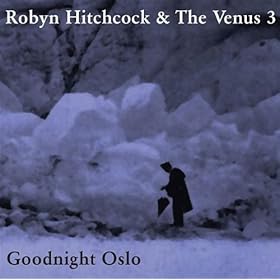 "Hurry For the Sky"
/ Robyn Hitchcock
& the
Venus 3
HAPPY BIRTHDAY,
ROBYN HITCHCOCK!!
Turning 56 today, Robyn Hitchcock -- a.k.a. "eccentric British rocker Robyn Hitchcock," as the music mags like to label him -- happens to have a new album out, Goodnight Oslo, which he recorded with R.E.M.'s Peter Buck and Bill Rieflin and the Minus 5's Scott McCaughey, performing under the name The Venus 3. Their last outing together, 2006's Ole Tarantula!, was where I first jumped on the Hitchcock fan wagon, and it's been a joyride for me ever since. I've now seen him four times in concert, though only once with the Venus 3; I have to say, I do love the way they stir up the rocker in him.
This two-chord song sounds to me like the theme from some absurdist western; underneath it all runs the insistent shush-shush of brushed drums and strummed guitar, clipping along at a hustling pace like a steam train, while lonesome steel guitar twangs whistle in and out like tumbleweed. All very Ennio Morricone, minor-key and moody. In fact, the song it first made me think of was "Perfect Crime," my fave track from the Decembrists' The Crane Wife album; and lo and behold I discover that the Decemberists' singer Colin Meloy is doing a guest-turn here on backing vocals. Niiiice.
Like many a Robyn Hitchcock number, though, "Hurry For the Sky" is not clearly about anything. Verses one and three are all platitudinal self-help advice ("Knock yourself out yesterday / Tomorrow will be fine"; "You can easily confuse / Money with success.") It helps, of course, to imagine the dark-eyed glitter with which Hitchcock is wont to deliver such adages; they're not meant to be taken seriously, except when they are. And just to throw you off course, verse two takes a sharp left turn into the Egyptian imagery that's a familiar Hitchcockian leitmotif: "Pharoah's tomb is empty now / You can come right in / Bandage up your grin / Bandage up your sin." I can imagine him writing that one after watching The Mummy on late night TV -- that "bandage up your grin" line kills me.
"Oh I," he intones in the chorus, his nasal voice sliding teasingly into that sustained note (another trademark device), "I'm in a hurry for the sky." I see big western horizons, and a silhouetted cowboy galloping into it; but no, wait, I also picture a cartoon heaven of fluffy white clouds and this reckless soul landing abruptly at St. Peter's gate. (I also think of the Kinks song "Big Sky," but maybe that's just me.) Whether he's hurling himself toward big dreams or the Big Sleep, he's clearly a restless questing spirit. While we're still riddling over that evocative phrase, he repeats it, this time swooping upward on "sky-eye," resolving the chord. But the way the tempo hurtles on without missing a beat, it doesn't feel resolved at all.
The final verse contains yet more koan-like teases: "Number two said to number one/ You fix this up or you're finished son / Number three said to number two / I wish I could trade boots with you / Number four said to number five /How does it feel to be eaten alive" -- who are these "numbers," threatening and cajoling each other? Naturally I recall The Prisoner, the cult 60s TV show, with its creepy group-think The Village inhabited by numbered strangers, all out to get each other. And somehow it loops back into the chorus: "Number five said / Oh I / I'm not an integrated guy / Oh I / I'm in a hurry for the sky." Not an integrated guy -- this from the fellow who brought you the song "Uncorrected Personality Traits" -- you gotta love it.
I don't care about "solving" this song, in the end. It's about mood, and the almost Cubist clash of images; it's about the song's texture, the faint sneer at the edge of Hitchcock's voice, and that hypnotic thrumming groove. For reasons I can't begin to explain, this song lifts me right out of myself, re-orders my thought patterns, and sets me down again in an ever-so-slightly altered state, not visible to the naked eye. But I know now.
Hurry for the Sky sample
Sunday, November 30, 2008
"Till I Hear It From You" /
The Gin Blossoms / Marshall Crenshaw
You know what? I love Marshall Crenshaw. Love the music; love the man too. I don't write about him often here, but I tell you, every time a song of his cycles up on my iTunes, it makes me happy. I was just reading about him in the paper today, in an article about an annual John Lennon tribute he often performs in (besides being a lifelong Beatle fan, Marshall got his show-biz start playing Lennon in Beatlemania). That inspired me to dial up my Marshallmania playlist, and it's been a beautiful day ever since.
But I have to apologize -- I can't post a sample of Marshall's version of this song. This one he co-wrote with the Gin Blossoms' Jesse Valenzuela and Robin Wilson, and while it became a hit for them -- it appears on their 1996 EP Follow You Down, on the the soundtrack of the movie Empire Records, and on both their "greatest hits" compilations -- Marshall's recording of it is more or less a rarity. I can't even remember how I got hold of that track; some illegal swap with another Crenshaw fan, I suspect. But to my ears, that soaring melodic line is quintessential Marshall Crenshaw, so I'm really sorry you'll have to make do with the Gin Blossoms' version.
Wait, that sounds snotty. The Gin Blossoms' version rocks! It's just that Marshall's is so much simpler and sweeter. First of all, he does it just with acoustic guitar and a contrapuntal fiddle (or is it a cello?) -- that homemade quality is perfect, like it's just a kid sitting in his bedroom feeling miserable. Then there's the matter of Marshall's voice, which after all these years still conveys adolescent bewilderment better than anyone, save Colin Blunstone of the Zombies (I mean, c'mon, "She's Not There" is the purest expression of adolescent yearning ever).
This is, after all, a song about trembling on the verge of heartbreak. The guy is singing it to his girlfriend -- although she isn't even there -- and stubbornly insisting that their relationship is not over. The more he protests, though, the more you know it's doomed. Apparently someone, or several someones, have been filling his ears with stories about her, which of course -- loyal sweetheart that he is -- he refuses to believe. "I didn't ask," he starts out, and "they shouldn't have told me," he adds. (He's got the teen code of ethics down just right, hasn't he?)
So what did she do? I can't help it, I'm dying to know. But he never tells us what they've told him (now there's a cagey bit of songwriting -- what Alfred Hitchcock used to call a McGuffin), maybe because he just can't face it. It's pretty clear that, whatever it is, it should kill the relationship. But he doesn't want to believe it, so he just digs in and shuts it out. "I don't want to take advice from fools," he tells us in the chorus, "I'll just figure everything is cool / Until I hear it from you / Until I hear it from you." He's either a total sap, or a glorious romantic -- I opt for the latter.
That melody is so plaintive, you just know what's gonna happen. The stories will be true; she's already ditched him. The quaver in Marshall's voice tell us that he knows this all perfectly well; he's just hanging on for the last few days, hours, minutes, forestalling heartbreak. The whole past, present, and future of this teenage love affair is telescoped into this one simple little plangent tune. It's heartrending, really.
The thing is, when you know Marshall Crenshaw's catalog, this is the kind of magic he works in song after song. Whatever the Gin Blossoms' input may have been (yeah, yeah, someday I really mean to listen to that band's music, I know I should), this is classic Crenshaw in all the ways that matter. The man's a treasure.
Till I Hear It From You sample
Monday, November 10, 2008
"Something to Talk About" /
Badly Drawn Boy
No, this isn't a cover of the Bonnie Raitt song, although I like that too. (Believe me, Bonnie and I go way back.) It's the theme song from a quietly brilliant little film from 2002, called About a Boy, starring Hugh Grant and based on a novel by Nick Hornby -- combine those two and how could you miss? I'm crazy about the both of them, no use pretending otherwise, and although I'd never heard of Badly Drawn Boy before, I fell in love with the charming soundtrack immediately. Later I found out that it was written by Damon Gough, who is Badly Drawn boy, in one of those I'm-one-guy-but-I-pretend-to-be-a-whole-band deals, a la Dashboard Confessional or Iron and Wine. So be it, I'm willing to keep an open mind. I'm vaguely aware that he dresses like Mike Nesmith gone grunge, but so what? And he cites his favorite artists as Bruce Springsteen, Jeff Buckley, and the Pixies -- well, two out of three ain't bad, as Meat Loaf used to say. (Or still says, for all I know.)
Man, am I cutting this kid slack. But really, let's face it, if the songs are good who cares about the rest? And the songs are good.
Acoustic guitar, a little spatter of keyboards, simple drumbeats, syncopated melody -- this is clean classic pop, married to quirky lyrics that would make Nick Hornby proud. (Have I ever told you guys about my Nick Hornby fixation? How his book Songbook changed my life? Remind me sometime.) The gist of the story -- which like any good story shouldn't be simplified -- is about a slacker cad (my man Hugh Grant) getting gradually entangled with a gawky adolescent and his awkward mother (the brilliant Toni Collette) and discovering that life's all about human connections. I know I know, it sounds like you'd retch at the cliches, but trust me, it works on screen, thanks to brilliant direction by the Weitz brothers Paul and Chris, and also a snarky smart screenplay by Peter Hedges (though from now on they should let Nick write his own screenplays because he's a genius and should get all the money. And Nick, really, if you google yourself and read this, email me because we need to talk).
But back to Badly Drawn Boy. What I love about this song is not only it's stop-and-start rhythmic pattern, which is so engaging, but the great throw-off quality of the lyrics, which matches the slacker sweetness of this movie. It's pretty much all embodied in the middle verse, which is the one I tend to sing to myself at random moments: "Ipso / Facto / Using up your oxygen / You know I'm shallow / Calling out for extra help / You've got to let me in / Or let me out." Well, that 's the movie in a nutshell, and there's some serious genius about getting a soundtrack that really marries to the storyline like that.
Plus, I don't know, but I love Gough's earnest folky voice. Sure, this is laid over with back-up oooh's and a kinda glossy arrangement (it's like a wall of sound writ small), but I find this warm and appealing, the same way as all the songs from the movie Garden State. Which is a whole 'nother story.
Let's cut to the last verse, which sums it all up: "I've been / Dreaming / Of the things I learnt about a boy who's / Leaving / Nothing else to chance again /You've got to let me in / Or let me out." Which is really the quandary we all face, isn't it? How do we manage to still be cool (as you all are) and remain engaged -- which you have to be, face it, to be cool these days. There's no checking out any more. What I love about Badly Drawn Boy is how he plays the groove between emotion and cynicism, understanding how hard it is to commit to lyrical impulse these days. This is a very narrow sector of the listening audience, I appreciate that. But hell, I'm there, and I'm hoping you are too.
Something To Talk About sample
Wednesday, November 05, 2008
"On the Road to Find Out" /
Cat Stevens
Apropos of nothing -- or maybe apropos of everything -- I've been stuck on this song ever since it popped up on my shuffle today. There are days when I can't remember what the Sixties felt felt like, but boy, yesterday sure wiped all the rust and dust off those Sixties ideals.
Suppose you were making a movie and you wanted to slap something on the soundtrack that says 1970; you couldn't go wrong with any song from Tea for the Tillerman. Okay, I know Hal Ashby already pulled that trick with Harold and Maude, but Tea for the Tillerman is so much more than just Harold and Maude for me. I was precisely the right age, and precisely the right target demographic, to think that this was the wisest and most beautiful album ever (at least for a few months, until Carole King's Tapestry came out). It seemed to be playing everywhere I went -- maybe not on Top 40 radio or on the musak at the mall, but at every party and at every friend's house. That folkie acoustic guitar, Stevens' quavery voice, the flower child conceits, the romantic loner alienation -- how better to appeal to us hippie wannabes?
"On the Road To Find Out" is your classic spiritual quest song, and we -- the generation that made Siddhartha a cult classic -- liked our spiritual quests, and the vaguer the better. The singer starts out by leaving his happy home "to see what I could find out," "with the aim to clear my mind out," et cetera et cetera et cetera, all very soft-focus and high-minded. It isn't all easy going -- he mentions snow, frost, thunder, howling winds -- and worst of all, human loneliness hits: "Then I found myself alone, hoping someone would miss me / Thinking about my home, and the last woman to kiss me (kiss me)." Still, he perseveres, as the chorus tells us over and over: "So on and on I go, the seconds tick the time out / There's so much left to know, and I'm on the road to find out." This is more Easy Rider than The Searchers, that's for sure.
Cat lays this down with swelling and climbing melodies, a distant chorus cheering him on, drums and a touch of bass and organ building up that folky guitar ever so subtly until it almost feels EPIC. We are totally with him -- or are we? Because I'll bet that ninety percent of the kids who wore the grooves off this LP still think it's about running away from home -- whereas, I now realize, it's about the folly of running away. Like he says in the last verse, "Then I found my head one day when I wasn't even trying / And here I have to say, 'cause there is no use in lying / Yes, the answer lies within, so why not take a look now? /Kick out the devil's sin, pick up, pick up a good book now." (Or is it "the Good Book" he's talking about? Knowing that Cat eventually became a serious Muslim, changing his name to Yusuf Islam, you've got to wonder.)
PICK UP A BOOK? That wasn't the message we wanted to hear -- that's like something the school librarian would tell you. And what we wanted was to go out of state to college and smoke dope and drop acid and live in communes until we found The Answer. It almost didn't matter what Cat Stevens was trying to tell us, we heard what we wanted to.
And you know what? It still doesn't matter. I still get that yearning to hit the road when I hear this song. And even if the answer lies within, I still want to believe there is an Answer. Yesterday gave me hope again that there is.
On the Road To Find Out sample
Thursday, September 04, 2008
"Fair" / Remy Zero
Not doing too well on the writing-only-quickies front, am I? Well, this one must be quick, because I know nothing about this band. I just got the Wikipedia facts -- they're from Birmingham, AL, were "discovered" by Radiohead, did three albums, got freaked out by fame, and split up; they all seem to be in other bands now. Oh, and one of them -- Cinjun Tate (how's that for a name?) -- was once briefly married to Alyssa Milano, whom I still think of as the little girl from Who's the Boss?, way too young to marry anybody.
And I only know this one song of theirs, which was on their 1998 album Villa Elaine. I probably should be ashamed to admit that I only discovered it through the movie Garden State, but honestly, it's a great soundtrack. This song's existential misery totally suits that movie -- mournful mumbled vocals, a slightly draggy melody, the hazy sonic clutter of its arrangement. Here's just a list of the melancholy buzz-words in the first couple of verses: lonely, damage, cold, fade, fallen, blue, fail. You don't even want to go there.
The lyrics don't make complete sense, but it seems to be about the singer clinging desperately to someone else who's a little more together than he is ("Where'd you go to? / But you're alive!"; "So what if you catch me /Where would we land?") That makes it perfect for that movie, which, if you haven't seen it, is about a numb overtranquilized slacker played by Zach Braff coming home to New Jersey for his mother's funeral and finally facing up to what a dysfunctional mess his life is (apparently sleeping with Natalie Portman helps him in this quest -- well, it makes sense in the context, honestly.)
It's a stunningly moody little film, with this killer soundtrack, and every time this song comes up on my shuffle I go into this weird dislocated head-space all over again. Remy Zero may have disappeared, but I'd like to hear more by them, and maybe investigate some of the bands they splintered into (starting with Spartan Fidelity, which is where Cinjun Tate went, along with Shelby Tate who looks to be his brother -- as if I needed another brother band to follow...)
Of course, to do that I'd have to have free time. Oh, someday, someday...
Fair sample
Tuesday, February 26, 2008
"Well Respected Man" / The Kinks
When Diablo Cody went to collect her Oscar last Sunday night for writing the film Juno, what song did the orchestra play? Even though most of the soundtrack is by Kimya Dawson, maestro Bill Conti went instead for "Well-Respected Man" -- great choice, sir!
When this song was released in 1965 (on the Kwyet Kinks EP in the UK, the Kinkdom LP in the States), it sure didn't fit the mold the Kinks had established for themselves with songs like "You Really Got Me," "All Day and All of the Night," "Tired of Waiting for You," and "Set Me Free." I remember hearing this one on the radio and being baffled when my older brother said it was the Kinks. Where were the grinding guitar chords, the inarticulate longing, the undertones of hostility and aggression?
Instead, here was a song that was actually...perky. And all those words! I hadn't a clue what British music hall sounded like, but I certainly hadn't heard it in rock & roll before. The earliest similar Beatles tune I can think of would be "Drive My Car," which Lennon & McCartney wrote in October '65, a month after the Kwyet Kinks EP came out. Coincidence? I think not.
Ray Davies knew what he was doing: The music hall style was perfect for social satire like this, and Ray gave it an extra spin with his slightly effete vocal and exaggerated pronunciation of the new polysyllabic lyrics. I love the eye-rolling emphasis of brother Dave backing up Ray on the repeated high notes of "OH SO good" and "OH SO fine" in the chorus. Between the bouncy rhythm and the flippant style, this send-up comes off as clever rather than vicious. There's always been a vein of sympathy in Ray's satire -- think of "Autumn Almanac," "Dead End Street," "Shangri-La," even "David Watts" (the one exception being "Dedicated Follower of Fashion" -- he doesn't cut that guy any slack.)
As the song develops, I feel more and more sorry for this well-respected man, boxed in by his job and his routine and his reputation and that awful controlling mother. I mean, what kind of joy is there, really, in a "world built 'round punctuality" and being "healthy in his body and his mind" and "doing the best thing / So conserva-tive-ly"? True, he is a self-satisfied prig, as Ray reminds us in verse three: "He likes his own back yard" (like in "Autumn Almanac," "This is my street / And I'm never gonna leave it"), he likes his cigarettes the best (were Jagger and Richards thinking of this song when they wrote "Satisfaction"?), and he even thinks "his own sweat smells the best." Notice how Ray gives up rhyming at this point, ending every line with the predictable "best," in perfectly clipped diction.
Ray explores the cracks in that polished facade in verse four: "And he goes to the Regatta, / And he adores the girl next door, / 'Cause he's dying to get at her." ("Regat-ta/ get at her" -- now there's a rhyme I would give anything to have written.) There is a bit of juice in the well respected man after all. But the manacles clamp down on him in the next line: "But his mother knows the best about / The mata-ri-mo-nial state." The guy hasn't got a chance.
Honestly, "You Really Got Me" disturbed me at age 10; I was way too young, and too much a girl, to become a Kinks fan based on those early singles. But this sort of stuff? It was much more my cup of tea. Of course, just a few months later the Kinks would mysteriously disappear from the US airwaves, and I'd lose sight of them until 1971. But the seeds of my Kinks addiction were already sown.
A Well Respected Man sample
Friday, November 16, 2007
“Let Him Dangle” / Elvis Costello
I’m so besotted with Elvis’ relationship songs (very few of them are really love songs, I’m afraid), I tend to overlook his political numbers. But there are plenty to choose from—Accidents Will Happen is loaded with them—and this morning, this chilling example from Spike popped into my head and just wouldn’t go away. Well, it’s been that sort of day.
“Let Him Dangle” is about a specific miscarriage of justice, a celebrated 1952 case where two teenagers breaking into a Croydon warehouse shot and killed a police officer. The 19-year-old, Derek Bentley, was hung for the crime, even though he didn’t shoot the gun; the shooter, Chris Craig, was only 16 so could not be executed under English law. Bentley was borderline retarded and probably not competent to be tried. Much of the case hinged around the fact that when the officers apprehended the kids on the warehouse roof, Bentley shouted “Let him have it, Chris” – which could have meant either “give him the gun” or “shoot him.” We'll never know.
Bentley was hung in 1953, before either Elvis or I was born, but the gruesome case lived on in tabloid culture. I saw a disturbing 1991 movie about it called Let Him Have It; Elvis’s song recites all the same names and details—“Bentley had surrendered, he was under arrest, / When he gave Chris Craig that fatal request / Craig shot Sidney Miles.” Still, the song’s about more than this one horrible case. “Well it's hard to imagine it's the times that have changed,” Elvis points out, with venom in his voice, “When there's a murder in the kitchen that is brutal and strange / If killing anybody is a terrible crime / Why does this bloodthirsty chorus come round from time to time?” It’s a savage rant against the death penalty, and against the mob hysteria that arises around certain cases.
And just to make sure no one escapes with their complacency intact, Elvis lets fly a final bridge that indicts the present age as well: “From a welfare state to society murder / Bring "back the noose" is always heard / Whenever those swine are under attack / But it won't make you even / It won't bring him back.” Bentley was finally granted a royal pardon in 1993 (four years after this song, two years after the movie), and the conviction was overturned in 1998—but he’d already been dead 45 years. Fat lot of good that did him.
The verses are minor-key, brooding, with a menacing sort of finger-snapping syncopation that feels very Fifties to me. There’s a distinctive Marc Ribot guitar riff wailing through it like a police siren, and Benmont Tench hammering wearily on the piano; somebody’s even whacking on a hubcap in the background, adding to that gritty urban texture. Elvis scornfully spits out the repeated word “dangle” in the chorus, following it up with a grim “doo-doo doo doo doo” that sounds to me like skeletons dancing.
Nobody else does political outrage like Elvis Costello. Dylan turns snide, Neil Young falls back on mottos, but Elvis takes no prisoners -- he just comes tangoing into the room like a Jesuit on a mission, and serves up this cocktail of vitriol and passion. Whew.
Let Him Dangle sample
Saturday, November 03, 2007
"Let My Love Open the Door" / Sondre Lerche
Yeah, yeah, I know Pete Townshend wrote this song. The trouble is, Pete Townshend's version is too bouncy, careless and confident -- there isn't a bit of pleading to it. I've always felt this song should be a whole lot more desperate and plaintive.
Last night, watching the movie Dan In Real Life, I finally heard the song the right way. It's a pivotal scene in the movie -- Steve Carell is accompanying his brother (played by Dane Cook) while singing this song, and the heartsick Carell slows it down and sings it so yearningly, it wins over Juliette Binoche. Carell's version is adorable; even better is this recording by Sondre Lerche, the Norwegian wunderkind who performed most of the film's brilliant soundtrack. Mark this up with Once and The Darjeeling Limited as three recent movie soundtracks that turn good movies into genius movies.
I knew nothing about Lerche, but I went straight home and listened to loads of his stuff, and I adore it. He totally gets the value of a spare arrangement -- Pete Townshend should take lessons from this kid. On "Let My Love Open the Door," behind Lerche's warm, endearing tenor he gradually layers in an acoustic guitar, then a cello, then the full string quartet, and finally a burst of handclaps. It builds, sure, but it never gets overblown.
It helps that Lerche's voice still has a trace of adolescent quiver and squawk -- it gives this song urgency, as well as sweetness and sensitivity. The old hackneyed truths about love still seem fresh to him -- "When people keep repeating / That you'll never fall in love / When everybody keeps retreating / But you can't seem to get enough / Let my love open the door." Repeating that phrase, as if hammering on a literal door, he allows just a little yelp on "open", matched by a heart-melting vocal crack on "To your heart."
I'm here to tell you, no woman is won over by a man who claims to have ALL the answers. Pete Townshend sounded like he thought he had all the answers; Sondre Lerche sounds like he doesn't even know that there are questions. In verse two, the line "I'll give you a four-leaf clover" always made me think Townshend was scraping for a rhyme to "all over"; Sondre Lerche delivers it so innocently, I can envision him picking the damn clover. He barges through all the song's wild claims -- "I have the only key to your heart, / I can stop you falling apart", "It's all I'm living for," "Only one thing's gonna set you free / That's my love" -- and I actually buy it. Not that I believe he'll deliver, but it's just so sweet that he thinks he can.
He even has the sense to hush and slow down the final verse: "When tragedy befalls you / Don't let them bring you down / Love can cure your problem / You're so lucky I'm around." (Another winsome crack as his voice rises to "I'm around".) He's just figured out that there is tragedy in life; it still sobers him up. But not for long -- love will find a way to fix everything. And at least for two minutes and twenty-seven seconds, I'm willing to believe it too.
Let My Love Open The Door sample
Tuesday, October 16, 2007
"Strangers" / The Kinks
It's not as if I haven't written about the Kinks before -- but here, for a change, is a Dave Davies original, which has been echoing in my brain ever since I saw the Wes Anderson film The Darjeeling Limited last weekend. The Darjeeling Limited is about three brothers and their complicated love-hate relationship, so how perfect is it to use songs by the warring Davies brothers. ("This Time Tomorrow" and "Powerman" are the other two Kinks tunes on the soundtrack.)
"Strangers" is one of those songs I tend to forget about, and not just because it's a Dave song -- with that heavy guitar strum, the distant echoing vocals, the lurching rhythm, it has a folky vibe I don't often associate with the Kinks. It could almost be a track from the Band; Dave's lonesome vocal here is distinctly Levon Helm-like. And the riddling question-and-answer lyrics definitely feel like a folk ballad: "Where are you going? / I don't mind / I've killed my world and I've killed my time / So where do I go, what do I see? / I see many people coming after me." I get a fugitive image there, for sure -- those people coming after him could easily be a posse riding him out of town. A classic folk ballad image, the exiled wanderer.
It's folky, yes, but apocalyptic too, and Dave is in truth-seeking mode here. Later on he says, "So you've been where I've just come / From the land that brings losers on / So we will share this road we walk / And mind our mouths and beware our talk / 'Till peace we find..." Whatever guru or messiah beckons at the end of this road, he's on some kind of a spiritual journey. (Though, as Owen Wilson says matter-of-factly late in the film, "We came here on a spiritual journey...but that didn't pan out.")
As the song lurches on, Dave begins to rebel against the whole spiritual shtick: "In a promised lie you made us believe / For many men there is so much grief / And my mind is proud but it aches with rage / And if I live too long I'm afraid I'll die." That's more like the Dave I know. I think back to 1970, when this song was released on the album Lola Versus Powerman and the Money-go-round Part One (by the way, Dave and Ray, we're still waiting for Part Two), and I recall George Harrison and all the hazy Eastern philosophy going around London's music world at the time. And there stands bad boy Dave Davies, wanting to believe in all this peace-and-love stuff, yet at the same time hating the idea of jumping on anybody else's flower-festooned bandwagon. Powerman is an album full of songs that reject accepted orthodoxies --labor unions, record company executives, music promoters, lawyers, bankers -- so why not kick back against religion while you're at it?
Still, the plaintive way Dave sings the chorus make his yearning for connection seem totally geniune. The quest still beckons, and it isn't a quest anyone should undertake alone. "So I will follow you wherever you go / If your offered hand is still open to me," Dave declares, leading into the refrain, "Strangers on this road we are on / We are not two we are one." It's a gorgeous hook, with its fluid, rippling triplets morphing from one key to another; I love how the voices split into harmony on the line "We are not two we are one," finally resolving on a major chord. Of course it's about the brotherhood of man, but for some reason I've never been able to hear this line without also thinking of Ray and Dave and their intense love-hate bond. Like it or not, it's been the one constant in their turbulent lives.
So what in the end does this song mean? I haven't got a clue. But then, neither does the singer of his song; he's just sitting at the side of the road, rubbing his aching feet and musing wistfully. The drums slap wearily along, an organ sighs like an exhaled breath. And somehow, all of this manages to come out haunting and evocative and tender. The moment when it bursts into the film, about two-thirds of the way through --well, I won't give away the plot, but it's a beautiful moment of acceptance and enlightenment, and this is the perfect song for that moment. Kudos to Wes Anderson for an absolutely inspired choice.
Strangers sample
Sunday, September 30, 2007
"Shama Lama Ding Dong" / Otis Day and the Knights
Flying home from Milwaukee in a post-Nick Lowe euphoria yesterday (more on that to come), I was seated next to an ineffably cool gentleman with long graying dreadlocks, obviously a musician -- the fact that everyone in his party was carrying a guitar case was a dead giveaway. It turns out that he was Gemi Taylor, guitarist for Otis Day and the Knights, en route to Orlando to play a Disney World gig. Ever since our delightful plane conversation I've had this song in my head -- no, not "Shout", which is the song Otis sings in the famous toga party scene in Animal House, but the one they sing later in the film, in the roadhouse scene, where Boon ecstatically greets the singer with the famous line, "Otis -- my man!"
Otis Day and the Knights, it turns out, was a band concocted specifically for the movie; DeWayne Jessie was an actor hired to play Otis, who'd never even sung professionally before. (I haven't fully researched this yet, but it looks like someone named Lloyd Williams actually sang the vocals used in the film.) But folks phoned up to offer them gigs once the movie was released, so of course they took them -- and they haven't stopped touring since.
Everybody knows "Shout", a pumped-up Isley Brothers hit that's perfect dance party material. "Shama Lama Ding Dong" is much mellower, with a groove just dripping with honey. I now learn that it was originally written by Otis Redding, which makes perfect sense -- that cha-cha rhythm, the supple melody, were Redding's stock in trade. But what I most love about this song is its light-hearted lyrics, which half the time seem to mean nothing at all: "Cause you shama lama / In the rama lama ding dong / Baby, you put the ooh mau mau (oh, oh, oh, oh) / Back into my smile child." Do "shama lama" and "rama lama" mean something specific in street slang? Does it matter? You can imagine what he means, and it's best left unspoken.
You almost have to dance, working your way into that bridge: "That is why / That is why-y-y / You are my sugar dooby doo." I love how Otis cascades over those extra syllables in the "why's." This thing is just so damn smooth it hurts.
Shama Lama Ding Dong sample
Tuesday, September 18, 2007
"Have You Ever Had It Blue" / Style Council
I've got a playlist on my iPod called simply blue; this song's the second track, and today when it came on it took me by surprise, the way a song sometimes does when you least expect it. I've been humming it ever since, and snapping my fingers too, because it's the sort of groovefest you must snap your fingers to.
I picked up "Have You Ever Had It Blue" up off the soundtrack for Absolute Beginners, that quirky 1986 Julien Temple film about the birth of teen culture in Britain. I have to admit, the main reason I own this soundtrack is because of its one delicious Ray Davies track, "Quiet Life," but I soon grew intrigued by this Style Council thing too.
I had no idea when I first heard it that Style Council was a Paul Weller project. Frankly, listening to this, who'd ever think this was the same guy who was in the Jam? It's chock-full of jazzy horns and samba rhythms and back-up singers, a total Big Production Number that fit the movie's 1950s time frame perfectly. (Can anybody tell me if this single was written for the movie?) But I guess I should have suspected something; after all, didn't the Jam do a song called "Absolute Beginners" in 1981?
Those image-laden lyrics are a fair indicator of what an evocative lyricist Weller can be: "Have you ever chased the night / That sailed in front of you / On a boat that's bound for hope / But left you in the queue / With your shouting waving / Taunting flaunting friends as crew." That's what I call developing an line of imagery, the mark of a true pro. I love that string of gerunds describing the friends -- "taunting flaunting" in particular is a nifty phrase. "Have you stood upon that dock / Have you ever had it blue ooh?" he wails urgently, with those percolating rhythms desperately popping away behind him. Time waits for no one.
The next verse is equally well crafted: "Have you ever woke to find / The morning didn't come / Undelivered with the papers / Stolen by someone / Found the milkman bound and gagged / And the shackles round the sun." It's a wonderful sustained metaphor, full of urban glints and hungover grogginess. And it pays off splendidly: "And the holder of the keys / Turns out to be the one / The girl you had your heart set on." Oof -- yeah, that's blue all right.
The soundtrack version is over five minutes, with a long dissonant jazz intro (a bit disorienting when it's piped into your ears on an iPod). I gather that the single version was more compact; the single didn't make much of an impression over here, though. I never heard of it, at any rate, outside of the movie. Not knowing who Style Council were, I assumed it was a period jazz piece when I first saw the film -- that's how effectively Weller switched genres.
And now I've Googled up this tasty black-and-white video to go with it: Have You Ever Had It Blue video. Enjoy!
Monday, July 30, 2007
“Lies” / Glen Hansard & Marketa Irglova
I just saw the movie Once yesterday evening, a new Irish indie film that’s positively glorious. It’s about a disillusioned Dublin musician who’s playing street corners for spare change, and the Czech immigrant who turns his life around. I don’t want to give away any plot details; all I’ll tell you is that the musician’s played by Glen Hansard (front man for the Frames, who played the guitarist in The Commitments eons ago) and the Czech woman is the absolutely luminous singer-pianist Marketa Irglova. This is one of the few musical movies I’ve seen lately in which the songs are completely organic to the action (forget the staginess of Moulin Rouge), and the songs are mostly haunting and passionate -- like “Falling Slowly,” “When Your Mind’s Made Up,” and the one that’s stuck in my head tonight, “Lies.”
“Lies” is an acoustic number, guitar and piano eventually joined by cellos and a mournful Irish fiddle. You’re drawn in by its soft, tentative beginning, but don’t worry, it builds to full heart-wrenching emotion – then pulls back for a delicate ending. It’s a song about a love affair faltering on the shoals of bad communication – “I think it’s time / We give it up / And figure out / What’s stopping us / From breathing easy / And talking straight” he suggests gently in the acoustic section, though soon enough he’s blasting her in the chorus: “I can see you’re only telling lies, lies, lies / Breaking us down with your lies, lies, lies / When will you learn?”
Okay, it’s not the first song on this topic, obviously, and it doesn’t really say anything new. But it says it beautifully, especially in the bridge: “The little cracks, they escalated,” Hansard sighs, going up in a whispery sweet falsetto; “Before we knew it was too late / For making circles / And turning round and round.” The way the two voices yearn together, soaring upward on “making circles” – it’s simply magic, and I defy you to resist.
Though Hansard says his chief songwriting influences are Bob Dylan and Leonard Cohen (join the club, Glen), his vocals remind me a lot of Cat Stevens. He’s got greater range, however, from that falsetto to a savage, urgent yelp, and Irglova’s pure soprano blends beautifully on back-up. This pairing was made in heaven (and apparently worked so well that Hansard and Irglova wrote more songs together than the movie required, releasing together another album, The Swell Season). I’m tempted to buy that one too, though I’m still sinking happily into the soundtrack CD (which was on sale at the movie concession stand – a no-brainer.)
I don’t know how wide the distribution for the film is at the moment; it’s only playing one art film house in New York right now, though it’s been around for at least a month. But if you see it playing anywhere near you, see it immediately. And if that’s not happening, get the soundtrack CD – you won’t be sorry.
Lies sample
Subscribe to:
Posts (Atom)